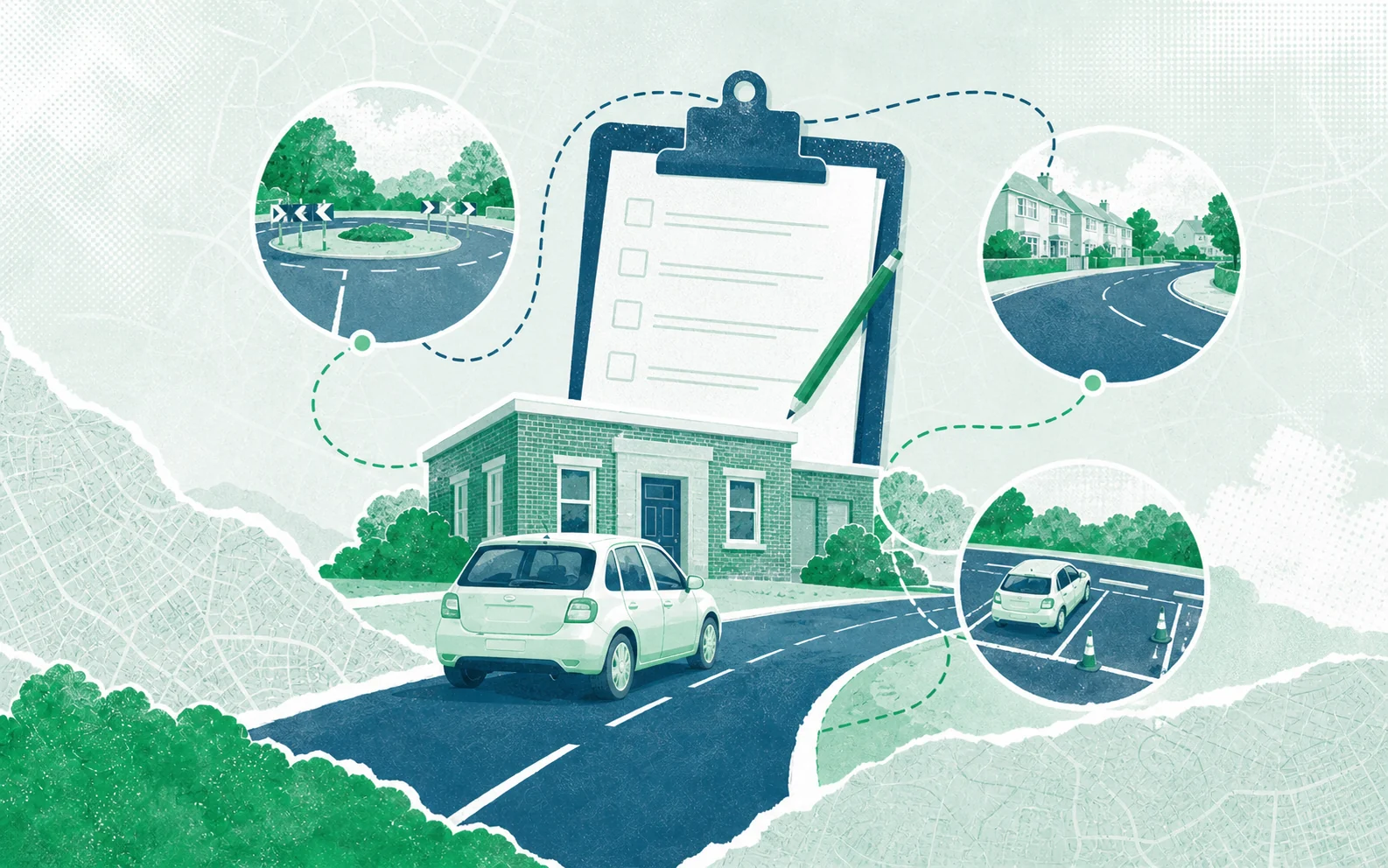
Most driving test failures come from a short list of recurring errors. According to DVSA data, the most common are poor observation at junctions, ineffective use of mirrors, weak steering control, incorrect road positioning, not responding properly to signs and signals, and poor move-off control. Any one of these, if it creates danger or shows a real weakness, can become a serious fault and fail your test.
The encouraging part is that these faults are well known and entirely avoidable with focused practice. Once you know what examiners see going wrong most often, you can target those exact skills before your test. This guide walks through the top fault categories from the DVSA’s published data and gives you a concrete way to avoid each one.
How does the driving test fault system work?
You pass if you make no serious or dangerous faults and no more than 15 driving faults, often called minors. A serious fault is one that is potentially dangerous or shows a significant weakness; a dangerous fault involves actual danger. Either type is an instant fail, no matter how well the rest of your drive goes.
There is also a trap in the minors. If you repeat the same minor fault often enough, the examiner can mark it as a serious fault, because a persistent habit is itself a safety concern. So passing is not just about avoiding one big mistake; it is about driving consistently well for the whole test. For the full breakdown of the test format, read our practical driving test guide.
What are the most common driving test faults?
The DVSA publishes the faults that cost candidates their test most often. The table below summarises the top categories and the core fix for each, and the sections that follow explain them in more detail.
| Common fault | What goes wrong | How to avoid it |
|---|---|---|
| Junction observation | Not looking properly before emerging or turning | Slow down, look fully both ways, only go when truly safe |
| Mirrors before signal or manoeuvre | Signalling or moving without checking mirrors first | Mirror, signal, manoeuvre, every time, in that order |
| Steering control | Hitting the kerb, over- or under-steering | Smooth, controlled inputs; look where you want to go |
| Road positioning | Sitting too close to the kerb or centre line | Keep a safe, consistent position for the road you are on |
| Response to signs and signals | Missing or misreading signs, traffic lights, road markings | Scan ahead constantly and plan early |
| Move-off control and safety | Stalling, rolling back, or pulling off without checks | Full observations, including blind spot, then a smooth pull away |
Why is junction observation the biggest fault?
Poor observation at junctions is consistently the single most common reason people fail, according to DVSA figures. It usually means pulling out or turning without looking effectively, or looking but not really assessing whether it is safe. Examiners see candidates creep out relying on other drivers to slow down, which is exactly the behaviour that causes real-world collisions.
The fix is to make your observations both thorough and genuinely effective. Approach every junction slowly enough that you could stop, look properly in each direction, and only move when you have decided it is safe, not when you hope it is. A good habit is to keep looking as you emerge, rather than committing after a single glance. Practise busy, awkward junctions with your instructor until safe observation becomes automatic.
How do you avoid mirror and signal faults?
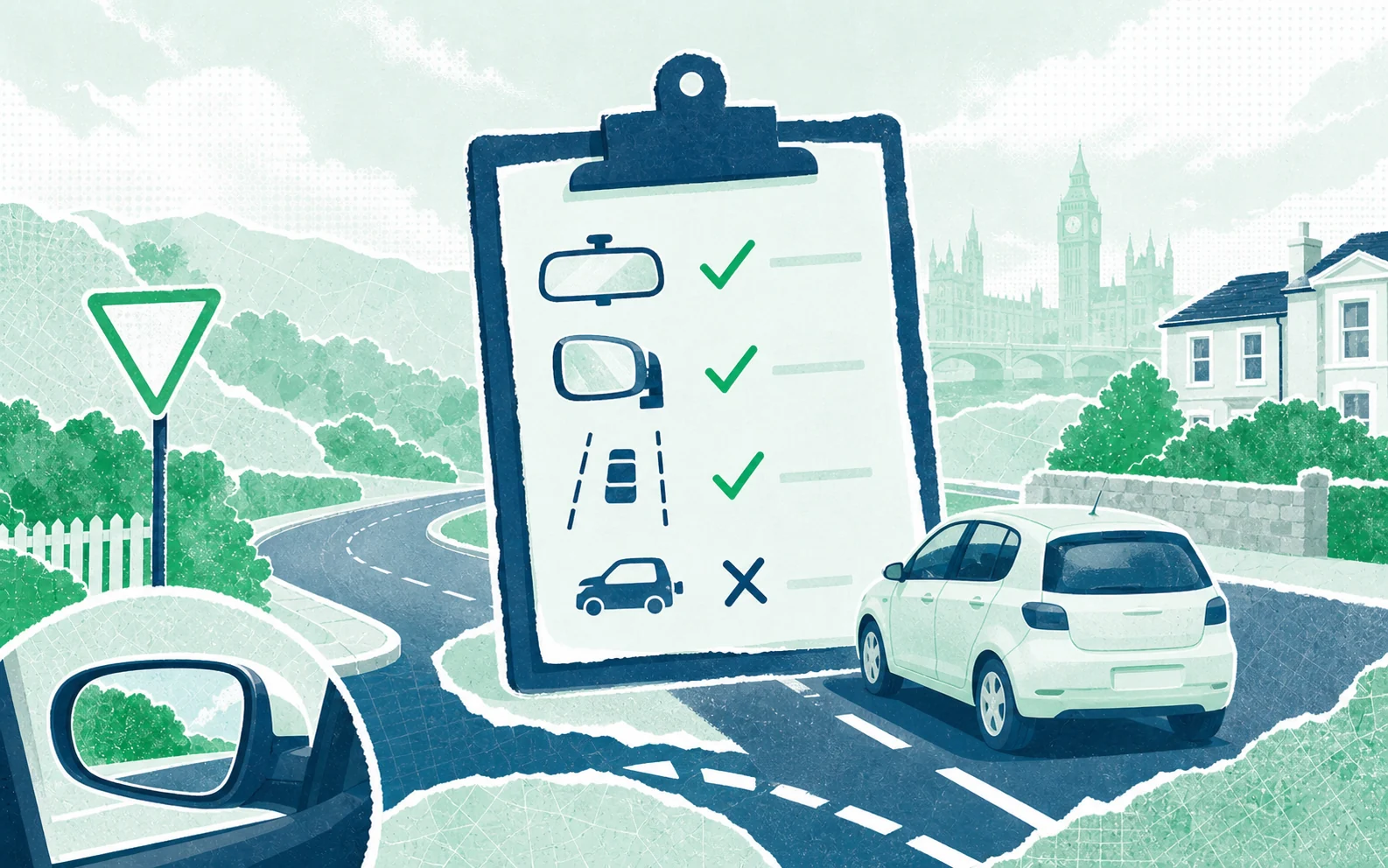
Mirror faults happen when candidates signal, change speed or change direction without checking their mirrors first. The examiner needs to see that you know what is around you before you act, so the sequence mirror, signal, manoeuvre must be second nature. Signalling before you have checked your mirror is a classic minor that quickly becomes a serious fault if repeated.
Build the routine into everything: before moving off, before turning, before changing lanes, before slowing for a hazard, check the relevant mirrors first. It is not enough to move your eyes; you must act on what you see. Examiners can tell the difference between a genuine mirror check that informs your driving and a token glance, so make your checks purposeful.
Why do learners lose marks on steering and positioning?
Steering faults include mounting the kerb, steering too early or too late, and jerky corrections. Positioning faults include driving too close to the kerb, drifting towards the centre line, or being poorly placed for a turn. Both come down to smooth control and reading the road ahead rather than reacting late.
To improve steering, look well ahead to where you want the car to go rather than fixating on the bonnet, and make gradual, controlled inputs. For positioning, aim to keep a safe, consistent distance from the kerb and parked cars, and get into the correct lane and position for junctions and roundabouts in good time. Regular practice on a variety of roads irons out both problems, which is where consistent lessons and private practice really pay off.
How do you handle signs, signals and moving off?
Faults in responding to signs and signals mean missing or misreading traffic lights, road markings, speed limits or other road users’ signals. The cause is nearly always looking too close to the front of the car. Scan far ahead, keep your eyes moving, and plan your response early so nothing catches you out. Late reactions turn manageable situations into rushed, faulty ones.
Move-off faults cover stalling, rolling backwards, and pulling away without proper checks, especially the blind spot. Every time you move off, whether from the side of the road or at a junction, make full observations including a blind-spot check, then pull away smoothly and under control. Nerves make stalling more likely, so practise clutch control until moving off is calm and reliable. If nerves are your main issue, our guide to driving test nerves has evidence-based ways to steady them.
How can you make sure you are ready?
The reliable way to avoid these faults is honest, targeted practice with a good instructor. Ask your ADI which of these areas is your current weakness and spend focused lessons on it rather than driving the same comfortable routes. Mock tests under realistic conditions expose the faults you make under pressure, which are the ones that matter on the day.
Do not book your test simply because a slot is free. Book it when your instructor agrees you are driving consistently and safely across all of these areas, because readiness is the single biggest predictor of passing. To understand how your chances compare, see our guide to driving test pass rates.
What about faults during manoeuvres and the show me, tell me questions?
Reversing manoeuvres attract faults too, usually a combination of lost control, poor accuracy and, most importantly, weak observation. Examiners want to see you keep looking all around throughout the manoeuvre, not just complete it neatly. A perfectly positioned reverse with no effective observation still earns a fault, and losing awareness of pedestrians or traffic while manoeuvring can become a serious one. Practise each manoeuvre until you can do it slowly, accurately and while checking all around.
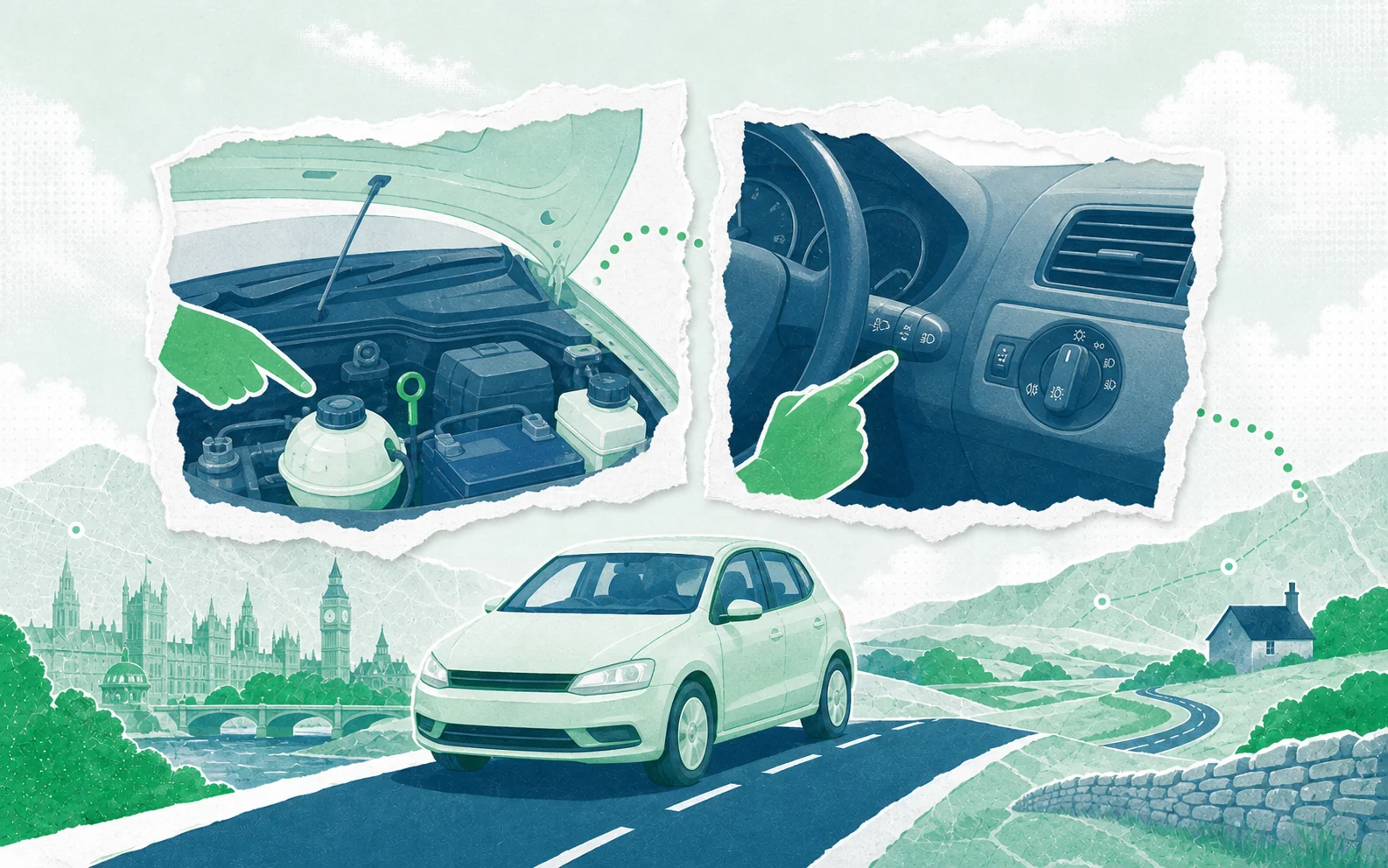
The show me, tell me questions can also cost you a minor, though only one in total however you answer them, so they never fail the test by themselves. The real risk is demonstrating a “show me” task unsafely on the move. Keep any demonstration simple and never let it pull your attention from the road. These are the easiest marks to protect, because the DVSA publishes every question in advance.
If you need an instructor who will drill these fault areas properly, you can find a driving instructor near you on Passly.