The UK practical driving test costs £62 on weekdays or £75 on evenings and weekends, lasts around 40 minutes, and checks that you can drive safely and independently. It includes an eyesight check, two vehicle safety questions, general driving, one reversing manoeuvre and about 20 minutes of independent driving. You pass with no serious or dangerous faults and no more than 15 driving faults. The national pass rate is around 48%.
This guide walks through booking, exactly what happens on the day, the manoeuvres and independent driving, how the faults system works, and what to do whether you pass or fail.
What is the practical driving test?
The practical driving test is the final stage of getting your full licence. A DVSA examiner sits beside you and assesses whether you can drive safely, confidently and independently on real roads. It is separate from, and comes after, the theory test, which you must have passed to book it.
The test is designed to reflect everyday driving rather than trick you. You will drive on a route around the test centre covering a mix of roads and traffic conditions, carry out one reversing manoeuvre, and drive independently for a stretch. The examiner is checking for safe, controlled, considerate driving, not perfection. A handful of small errors will not fail you.
How much does the practical test cost and how do you book it?
The car practical test costs £62 on weekdays and £75 in the evenings, at weekends and on bank holidays. You book through the official GOV.UK service, and you will need your provisional driving licence number and your theory test pass certificate number.
| Item | Detail |
|---|---|
| Weekday test fee | £62 |
| Evening, weekend and bank holiday fee | £75 |
| Where to book | Official GOV.UK service |
| What you need | Provisional licence number, theory pass certificate number |
| Test length | Around 40 minutes |
| To rebook after a fail | Wait at least 10 working days |
Only ever book through GOV.UK. Third-party sites frequently charge a markup for a booking you can make yourself in minutes. You can also change or cancel your test through the same service, though short-notice changes may forfeit the fee. Book the test only when your instructor agrees you are ready, not simply because a slot is free.
What happens on the day of the driving test?
Arrive early, with your provisional licence, and expect a clear sequence of steps. The examiner meets you in the waiting room, checks your licence and asks you to sign a declaration confirming your car is insured for the test. You then walk out to the car together.
The test runs in this order:
- Eyesight check. You read a number plate from about 20 metres. Fail this and the test ends there.
- “Tell me” question. Before you drive off, the examiner asks one vehicle safety question you answer verbally.
- General driving. You drive on a set route covering a range of road and traffic types.
- “Show me” question. While driving, the examiner asks you to demonstrate one safety task.
- Reversing manoeuvre. One manoeuvre from the set list, when the examiner asks.
- Independent driving. About 20 minutes following a sat nav or road signs.
- Result. Back at the test centre, the examiner tells you whether you passed and talks through any faults.
The examiner assesses you from the moment you drive away, so treat the whole appointment as the test. You are allowed to have your instructor sit in the back if you wish.
What are the show me, tell me questions?
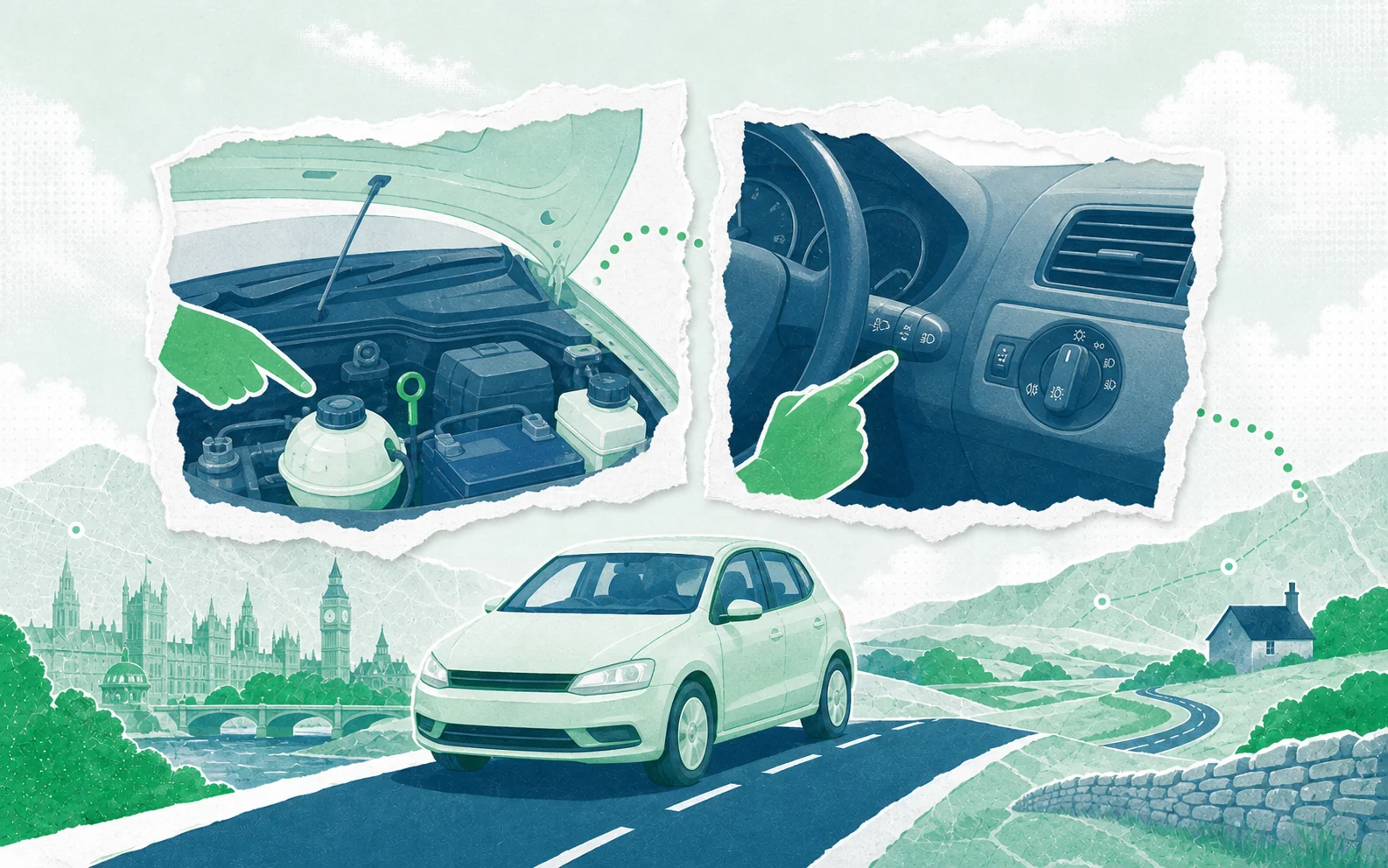
These are two vehicle safety questions from a fixed published list. The “tell me” question comes before you start driving, and you explain how you would carry out a safety check, for example how you would check the brakes are working. The “show me” question comes while you are driving, and you demonstrate a task such as operating the rear windscreen demister or washing the windscreen.
Getting either question wrong is recorded as a single driving fault, so it cannot fail you on its own. Still, they are among the easiest marks to secure because the full list is published in advance. Our guide to the show me, tell me questions covers every current question with model answers so you can learn them all.
What manoeuvres are in the driving test?
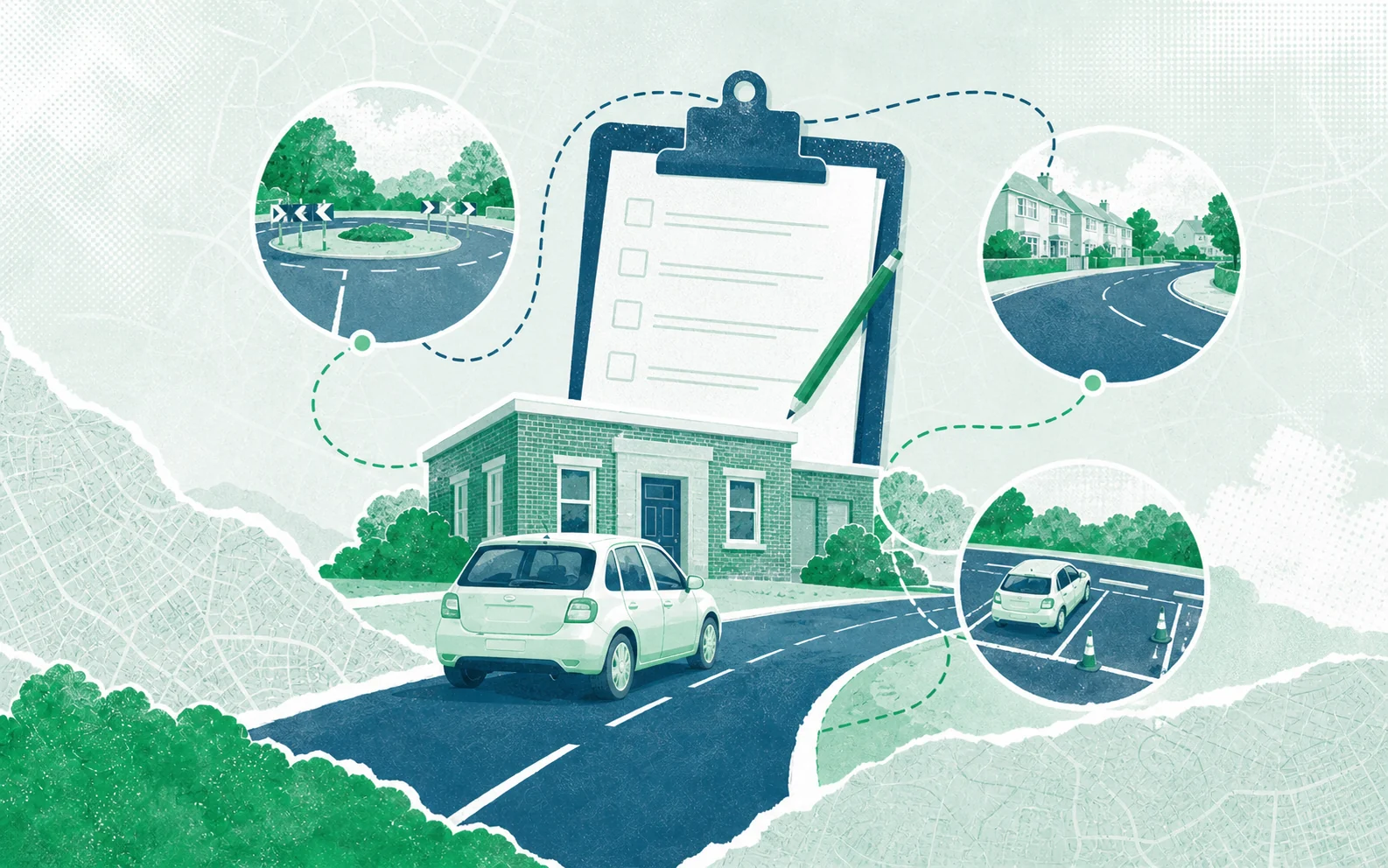
The examiner asks you to carry out one reversing manoeuvre, chosen from a set list. You will not know which one you get until the examiner asks, so you need to be confident with all of them:
- Parallel parking at the side of the road behind a parked car.
- Bay parking, either reversing into a bay and driving out, or driving into a bay and reversing out. This is usually done at the test centre car park.
- Pulling up on the right, then reversing back about two car lengths and rejoining the traffic.
Some tests also include a controlled stop (an emergency stop), asked of about one in three candidates. Because you cannot predict which manoeuvre you will be given, practise each one until it is second nature. Getting a manoeuvre slightly wrong is often recoverable if you spot it, stop safely and correct it under control.
What is the independent driving section?
For roughly 20 minutes, you drive independently, making your own decisions rather than following turn-by-turn instructions from the examiner. Most tests use a sat nav that the examiner provides and sets up for you; a minority ask you to follow traffic signs instead. You do not need to bring or set up anything.
The point of this section is to see how you cope with real-world driving where you are responsible for the navigation as well as the driving. You are not being marked on navigation, so if you go the wrong way it does not count against you, as long as you drive safely while doing it. If you miss a turn or the sat nav is unclear, stay calm, keep driving safely, and the examiner will help you get back on route.
How does the driving test faults system work?
There are three levels of fault, and understanding them tells you exactly what you can and cannot afford.
| Fault type | Meaning | Effect on result |
|---|---|---|
| Driving fault (minor) | A minor error with no immediate danger | Up to 15 allowed; 16+ is a fail |
| Serious fault | Could be potentially dangerous | Any single one is an immediate fail |
| Dangerous fault | Involves actual danger to people or property | Any single one is an immediate fail |
You pass with no serious or dangerous faults and no more than 15 driving faults. One important catch: if you repeat the same driving fault throughout the test, the examiner can escalate it to a serious fault, because a recurring error shows a habit rather than a one-off slip. So the target is not “15 minors”: it is as few as possible, and zero serious or dangerous. Our guide to the most common driving test faults breaks down the errors that fail the most learners and how to avoid each.
What is the pass rate and what affects it?
The national pass rate for the car practical test is around 48%, according to DVSA figures, so roughly half of candidates pass on a given attempt. Pass rates vary by age, experience and test centre, but by far the biggest factor within your control is genuine readiness.
Learners who pass first time are almost always the ones who took the test only when properly prepared, not the moment a slot opened. Plenty of private practice alongside lessons, mock tests under realistic conditions, and taking your instructor’s advice on timing all move the odds in your favour. For a fuller look at the numbers, see our guide to driving test pass rates.
What should you take to your driving test?
Turning up without the right documents means the test is cancelled and you lose your fee, so check this the night before. You need your provisional driving licence, and you must have passed your theory test: the examiner confirms your entitlement from your booking, but you should know your details are in order.
You also need a car that is roadworthy, taxed, insured for the test and displaying L plates (or D plates in Wales). Most learners use their instructor’s car, which is already set up correctly with dual controls, and this is by far the safest option because it is the car you have trained in. If you plan to use your own car, confirm well in advance that it meets the DVSA’s rules on age, condition and features, as some cars are not eligible. Bring your glasses or contact lenses if you need them to read a number plate at 20 metres.
What are the most common reasons people fail?
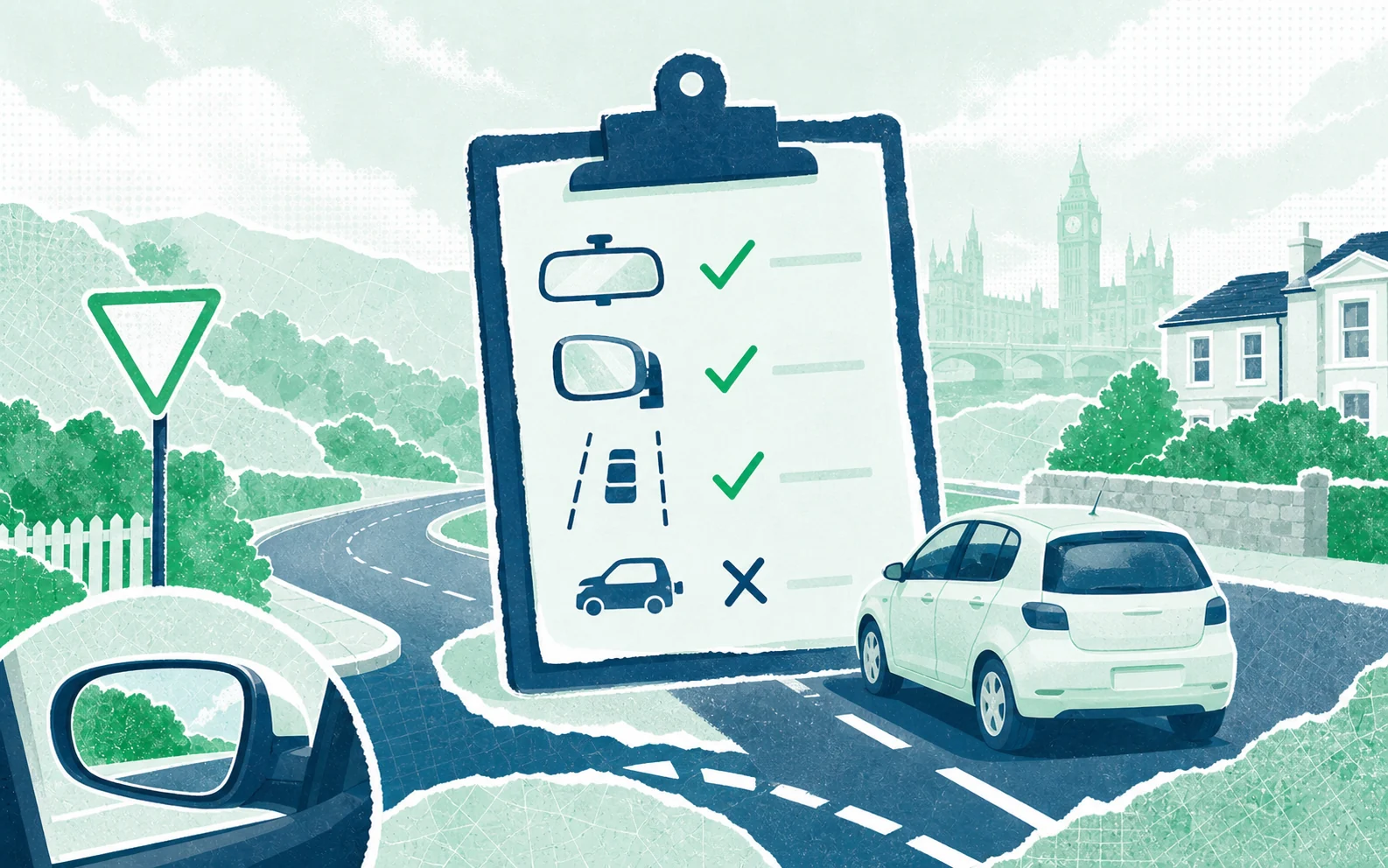
Most fails come from a small number of recurring faults rather than dramatic mistakes. According to DVSA data, the errors that catch out the most learners include not making effective observations at junctions, poor use of mirrors when changing direction, incorrect positioning during normal driving, and not responding properly to traffic signals.
The reassuring news is that these are all habits you can drill with your instructor before the test. Because a repeated minor fault can be escalated to a serious one, ironing out a recurring weakness is often the single most valuable thing you can do in your final lessons. Our guide to the most common driving test faults covers the top reasons learners fail and exactly how to avoid each.
What happens after you pass or fail?
If you pass, the examiner gives you a pass certificate and you can drive on your own straight away: your full licence is issued by the DVSA, usually automatically, and you can surrender your provisional to have the photocard sent to you. You may still pick up a few driving faults and pass; the examiner will point them out so you keep improving.
If you fail, the examiner explains which faults let you down and hands you the marking sheet. You must wait at least 10 working days before taking another test, and you pay the fee again. Do not simply book the next available slot. Use the feedback to target a few focused lessons on your specific weaknesses first. Nerves play a big part on the day, so if that is your issue, read our guide to driving test nerves.
How do you get ready for the practical test?
Readiness comes from consistent, well-structured practice, not from booking a test and hoping. Take regular lessons with a qualified instructor, build private practice hours in between, master every manoeuvre, learn the show me, tell me questions, and sit mock tests so the real thing feels familiar. When your instructor says you are ready, you probably are.
If you are still earlier in the journey, our full guide on how to learn to drive lays out every stage in order. When you are ready to book lessons or step up your preparation, find a driving instructor near you on Passly with real reviews and online booking, and get test-ready with someone who knows your local test routes.