To learn to drive in the UK, apply for a provisional licence from age 15 years and 9 months (£34), take driving lessons from age 17, and pass two tests: the theory test (£23) and the practical test (£62). Most learners need around 45 hours of lessons plus 22 hours of private practice, according to DVSA guidance, before they are ready to pass.
That is the whole journey in a sentence. The rest of this guide breaks each stage down in order, tells you what it costs and how long it takes, and points you to the detail you will need at every step. Follow it from top to bottom and you will always know what to do next.
What is the first step to learning to drive?
Get your provisional driving licence. Nothing else can happen until it arrives, so treat this as step one. You can apply online through GOV.UK from the age of 15 years and 9 months, and it costs £34 (or £43 by post). You will need proof of identity, such as a passport, your addresses for the last three years and your National Insurance number.
The card usually arrives within one to two weeks. You can hold it before you turn 17, but you cannot drive a car on a public road until your 17th birthday, or 16 if you receive the enhanced rate of the mobility component of Personal Independence Payment. Applying early means your licence is ready to go the moment you can legally start. Our guide to applying for your provisional licence walks through the form field by field.
How old do you have to be to learn to drive?
You can drive a car on the road from 17. The main exception is that you can start at 16 if you receive the enhanced rate of the mobility component of Personal Independence Payment. There is no upper age limit for learning, and plenty of people pass in their thirties, forties and beyond.
Age is only part of the picture. Insurers, examiners and instructors all know that regular, well-supervised practice matters far more than how old you are. What counts is time behind the wheel and the quality of the tuition you get, not rushing to book a test the week you turn 17.
Do you need a driving instructor to learn?
You are not legally required to pay for lessons, but the DVSA recommends professional tuition and most learners take it. A qualified approved driving instructor (ADI) teaches you to drive safely from scratch, structures your learning so you build skills in a sensible order, and knows exactly what the practical test demands.
The alternative or supplement is private practice with a friend or family member. To supervise a learner they must be over 21, have held a full licence for that category of vehicle for at least three years, and the car must have L plates and suitable insurance. In practice, the most cost-effective route is a mix: regular lessons with an ADI to learn each skill properly, plus private practice in between to bank the hours cheaply. Our guide to choosing a driving instructor covers grades, reviews and the questions worth asking, and you can find a local instructor on Passly with real reviews and online booking.
Manual or automatic: which should you learn in?
Decide this before your first lesson, because it affects what your licence lets you drive. If you pass your test in a manual car, you can drive both manual and automatic vehicles. If you pass in an automatic, your licence only covers automatics until you take a further test in a manual.
Manuals give you more freedom and are still the most common car on UK roads and forecourts. Automatics remove the clutch and gears, which many learners find lets them focus on road awareness sooner, often meaning fewer lessons. With more electric and hybrid cars on the road, automatic-only licences are becoming more practical than they once were. Weigh up the cars you expect to drive and buy, then read our full comparison of manual versus automatic lessons.
How many lessons will you need?
DVSA guidance points to an average of around 45 hours of professional lessons plus about 22 hours of private practice. Treat that as a guide, not a finish line. Some learners need far fewer, others more, and readiness is about consistent, safe driving rather than clocking a set number.
A few things push the number up or down:
- Age and confidence. Younger learners and confident drivers often need fewer hours.
- Frequency. Two lessons a week retains more than one lesson a fortnight, so you cover the ground in less overall time.
- Private practice. Every supervised hour off the clock reduces how many paid lessons you need.
- Nerves. Anxiety can slow progress; the fix is exposure and good coaching, not simply more lessons.
For a fuller breakdown by age and experience, see how many driving lessons you need and how long it takes to learn to drive.
Should you learn weekly or take an intensive course?
Most learners spread lessons over several months, taking one or two a week and building private practice around them. This weekly rhythm suits the majority of people because driving is a skill that embeds through repetition and rest, and it gives you time to practise between sessions.
The alternative is an intensive or “crash” course, where you compress your learning into one or two weeks and sit the test at the end. Intensive courses suit people who need a licence quickly, already have some experience, or learn well under concentrated pressure. They cost more up front and are demanding, and their pass rates are not automatically higher than the weekly route. If you are weighing this up, read our honest guide to intensive driving courses before you book.
How does private practice fit in?
Private practice is the most effective way to reduce both the time and the cost of learning to drive. Every hour you spend driving with a supervising friend or family member is an hour of real experience that you have not paid an instructor for, and the DVSA counts private practice as a core part of getting test-ready.
To practise legally, the person supervising you must be over 21, have held a full licence for the relevant category of vehicle for at least three years, and sit in the front passenger seat. The car needs L plates front and rear and correct learner insurance, which you can usually add as a short-term policy. Use private practice to consolidate what your instructor teaches rather than to learn brand-new skills, so you do not build bad habits. Our guide to private practice for learner drivers covers the rules and insurance in detail.
How much does it cost to learn to drive?
The fixed costs are small; lessons are the big expense. Here is what to budget for from start to full licence.
| Item | Typical cost | Notes |
|---|---|---|
| Provisional licence | £34 | £43 if you apply by post |
| Theory test | £23 | Same price at every test centre |
| Practical test | £62 weekday / £75 evening & weekend | Booked through GOV.UK |
| Driving lessons | ~£1,500+ | Around 45 hours at typical UK hourly rates |
| Theory revision materials | £0 to £30 | Official app and books; free resources exist |
| Learner insurance (optional) | Varies | For private practice in someone else’s car |
| Approximate total | £1,600 to £2,000+ | Lower with more private practice |
Lessons dominate the total, so the single biggest lever on cost is private practice: every hour you drive in an insured car with a supervising driver is an hour you do not pay an instructor for. Our guide to how much driving lessons cost breaks down regional prices and ways to spend less.
What happens in your first driving lesson?
Your instructor collects you, drives somewhere quiet, and starts with the cockpit drill: adjusting your seat, mirrors and steering position, and learning the main controls. You will usually get moving in a low-traffic area, practising pulling away, changing gear (in a manual) and stopping safely.
It is normal to feel nervous, and a good instructor expects it and paces the lesson to you. Bring your provisional licence and glasses or lenses if you need them for driving. You will not be thrown onto a dual carriageway on day one. For a full walkthrough of what to expect and how to prepare, read your first driving lesson.
How do you pass the theory test?
The theory test has two parts and you must pass both in the same sitting. First, 50 multiple-choice questions, where you need 43 correct to pass. Second, the hazard perception test: a series of video clips where you click as developing hazards appear, scored out of 75 with a pass mark of 44.
Book it through GOV.UK for £23 once you have your provisional licence. Revise with the official DVSA question bank, the Highway Code and hazard perception practice clips, and do plenty of timed mock tests so the format holds no surprises. Passing theory is a prerequisite for booking your practical, and your theory pass certificate is valid for two years, so do not leave the practical too late. See our theory test guide and hazard perception tips for how to prepare.
How do you pass the practical test?
The practical test lasts around 40 minutes and assesses whether you can drive safely and independently. It includes an eyesight check, two vehicle safety “show me, tell me” questions, general driving on a set route, one reversing manoeuvre, and about 20 minutes of independent driving following a sat nav or road signs. Most tests also include a hill start or similar.
You pass if you make no serious or dangerous faults and no more than 15 driving (minor) faults. The national pass rate is around 48%, according to DVSA figures, so roughly half of learners pass first time. Take the test only when your instructor agrees you are ready, not just when a slot is free. Prepare with our practical driving test guide, the show me, tell me questions and the most common test faults.
How can you manage test-day nerves?
Nerves are normal and manageable. The most effective fix is preparation: taking the test only when you are genuinely ready, doing mock tests under realistic conditions, and using your instructor’s familiar car. Knowing exactly what will happen removes most of the fear.
On the day, sleep well, arrive early, and use slow breathing while you wait. Remember the examiner wants you to pass and is only checking that you drive safely, not perfectly. A handful of minor faults will not fail you. For evidence-based techniques, read our guide to driving test nerves.
If you do not pass first time, you are in good company: with a national pass rate of around 48%, roughly half of all candidates fail, and most go on to pass on a later attempt. Ask your examiner and instructor exactly which faults let you down, spend a few focused lessons on those specific weaknesses, and book your next test when you have genuinely fixed them rather than immediately. To understand the numbers and what actually moves them, see our guide to driving test pass rates.
What order should you do everything in?
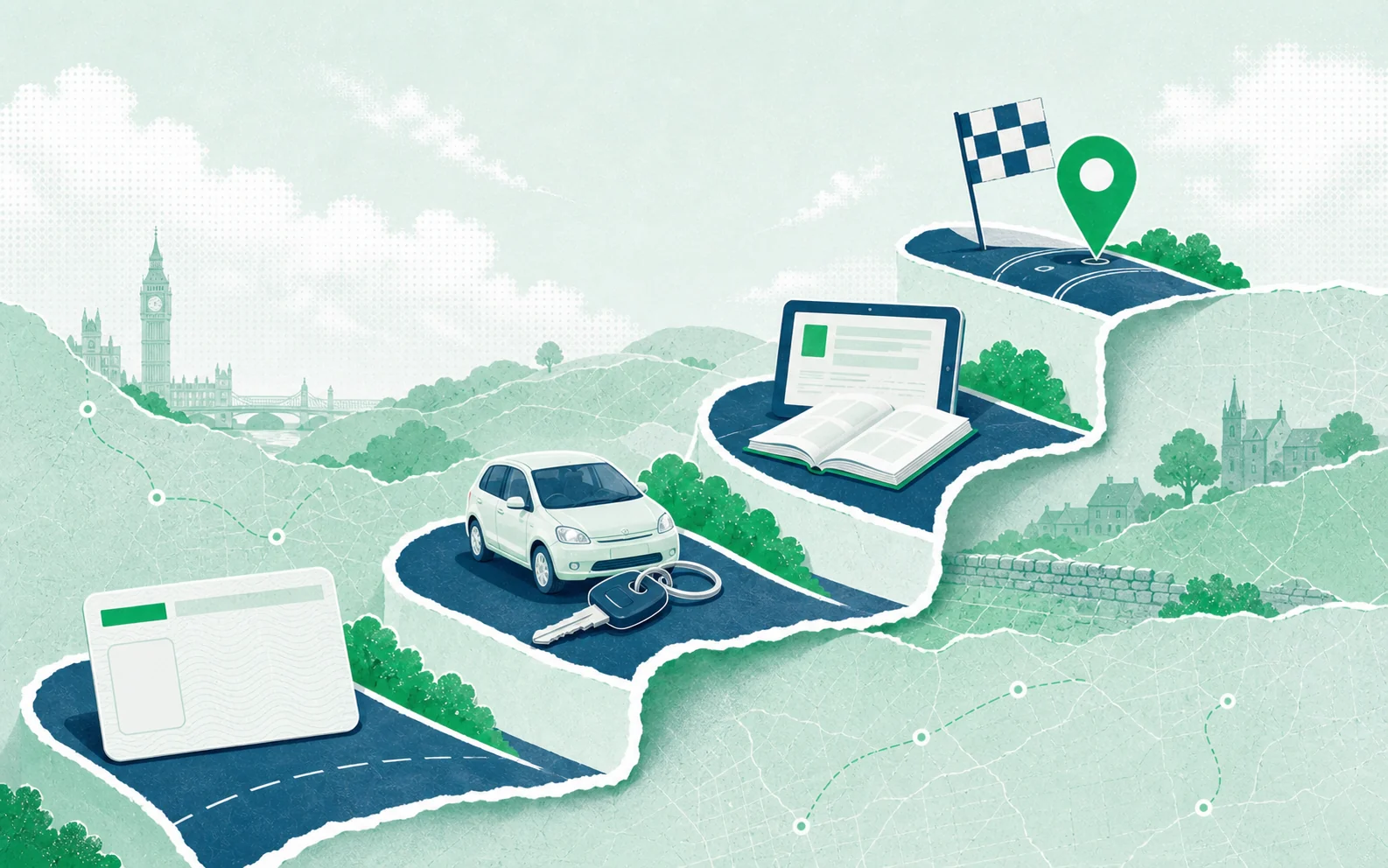
Here is the whole process as a simple sequence:
- Apply for your provisional licence from 15 years 9 months (£34).
- Start lessons on or after your 17th birthday with a qualified ADI.
- Practise privately where you can, with a supervising driver and proper insurance.
- Revise and pass the theory test (£23) once your provisional has arrived.
- Book and pass the practical test (£62) when your instructor says you are ready.
- Get your full licence, which the DVSA issues automatically after you pass.
Work through it at your own pace. There is no prize for rushing, and the learners who pass first time are almost always the ones who were properly prepared. When you are ready to begin, find a driving instructor near you on Passly and book your first lesson online.